
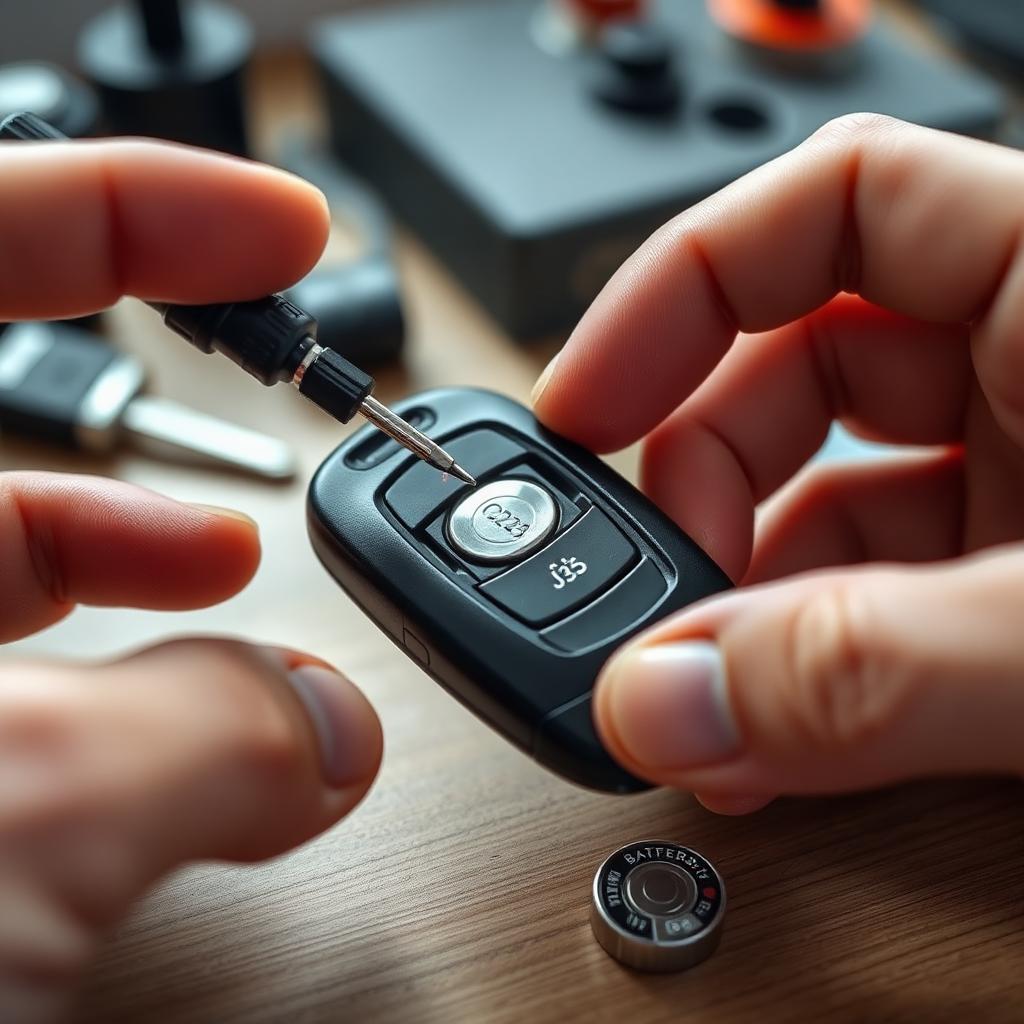
Five signs your key fob battery is dying
A fob battery never dies silently — it fades over two to four weeks, and the symptoms arrive in a predictable order. First, you need to stand closer to the car than usual. Then the buttons need a second or third press. Many cars then show a 'key fob battery low' message on the dashboard, and some flash the security light differently.
The final stage is the most inconvenient: push-to-start cars stop detecting the fob from your pocket, so you have to hold it against the start button or a marked spot on the steering column. That emergency detection coil is designed for exactly this situation — if you are using it daily, the battery has days left, not weeks.
One caution before you buy anything: if only ONE button has stopped working, the problem is usually a worn button contact, not the battery. A battery affects everything at once.
Which battery your key fob actually needs
Almost every modern fob runs on a 3-volt lithium coin cell, and four sizes cover roughly 95% of vehicles: CR2032, CR2025, CR2016, and CR2450. The letters mean nothing — the numbers are the dimensions. A CR2032 is 20mm across and 3.2mm thick; a CR2025 is the same diameter but thinner.
CR2032 is the most common by far — most Toyota, Honda, Ford, Chevrolet, Hyundai and Nissan fobs use it. CR2025 appears in many Volkswagen, BMW and Mercedes fobs. Some older GM and Ford fobs stack two CR2016 cells. The battery number is printed on the old cell itself, and it is also in your owner's manual under 'remote battery'.
Buy the same number that came out. A thinner cell in a thicker slot rattles, loses contact over bumps and causes exactly the intermittent problems you were trying to fix. A thicker cell simply will not fit without cracking the case.
How to open the fob without breaking it
First, remove the mechanical key blade. On most fobs there is a small release button or slide on the back or side — press it and pull the blade out. Set it aside; you will not need it again until reassembly.
Look for the seam where the two halves of the shell meet. Most fobs have a small notch near the key slot designed for a pry tool. Insert a small flathead screwdriver, a plastic pry tool, or even a coin, and twist gently. You are releasing plastic clips, not cutting glue, so slow twisting pressure works — levering force does not.
Two warnings from experience. Never pry at the button side — that is where the circuit board sits closest to the seam. And if a fob resists, look for a hidden screw under a sticker or rubber pad before applying more force. Some Toyota and GM fobs hide one there.
Swapping the battery — the step everyone gets wrong
Once open, note which way the old battery faces before touching it. In most fobs the positive side — the smooth side with the writing — faces up, but Honda and some European fobs mount it face-down. Take a photo with your phone first. This thirty-second habit prevents the single most common DIY failure: a brand-new battery installed backwards.
Slide the old cell out sideways rather than prying it upward — many holders have fragile retaining tabs that snap under vertical force. Avoid touching the flat faces of the new battery with bare fingers; skin oils measurably shorten coin-cell life. Hold it by the edges.
Press the new cell in until it clicks or sits fully flat, then test the buttons while the fob is still open. If nothing happens, the battery is backwards or not seated — far easier to fix now than after snapping the case shut.
Reassembly, testing, and what to do if it still fails
Snap the shell back together starting from the end opposite the clips you released first. Press around the whole seam until every clip clicks — a partially closed seam lets in moisture, and moisture kills circuit boards faster than anything else. Slide the mechanical blade back in last.
Test everything: lock, unlock, trunk, panic, and remote start if equipped, from at least 30 feet away. Then sit in the car and confirm push-to-start works normally. A correct battery swap restores full range immediately — there is no 'break-in' period.
If a fresh battery changes nothing, the fault is inside the fob: cracked solder joints on the battery holder, a worn button membrane, or water damage. Those are repairable or replaceable, but they are no longer a battery job. Similarly, if the car still will not start with a working fob, the problem is the transponder or the car's antenna — a diagnostic issue, not a coin cell.
What a battery costs — and when to call a locksmith instead
A CR2032 or CR2025 costs $3 to $8 at any Austin, TX pharmacy, grocery store or hardware counter. The whole job takes under five minutes once the fob is open. Dealerships charge $20 to $50 for the same swap, so this is one of the highest-value DIY jobs in motoring.
Call a professional when the case is sealed or glued (some BMW, Mercedes and Tesla fobs are), when the buttons or shell are physically broken, when the fob got wet, or when a new battery does not restore function. At that point you need fob repair, shell replacement or a new programmed fob — and doing more prying yourself usually converts a $15 fix into a $200 fob.
Here in Austin, TX we keep every common fob battery on the van, and we replace batteries free with any other service call. If your fob needs more than a battery, we can test it, repair the board, or cut and program a replacement at your location — home, office or roadside, 24/7.
Battery swap did not fix it? We repair fob boards, replace cracked shells and program new fobs at your location, 24/7 across Greater Austin.
Key fob replacement & repair in Austin, TX