
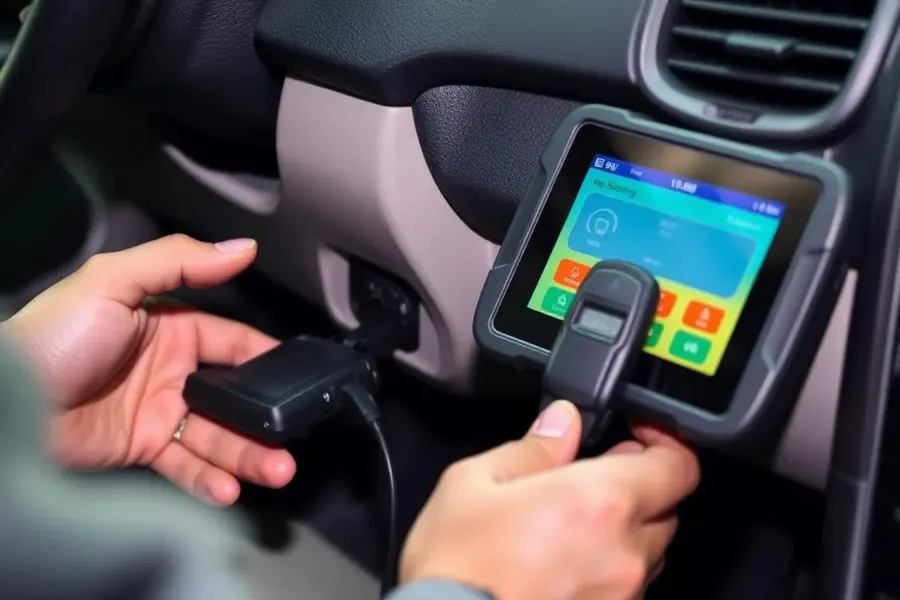
Start with the battery — but test it properly
A coin cell that reads fine on a meter can still collapse under the current draw of a transmission. If the fob works when pressed within a foot of the door but not from across a parking lot, suspect the battery even if it 'tests good'.
Rolling-code drift
Keyless entry uses a code that advances every press. Pressing the buttons repeatedly far from the vehicle — in a pocket, in a bag — pushes the fob outside the acceptance window. The car is fine, the fob is fine, and re-syncing restores everything without buying a part.
Water and corrosion
Lake Travis, Barton Springs and washing machines account for a remarkable share of Austin, TX fob failures. Once the board corrodes, a new shell will not help. A quick bench test tells you definitively whether the electronics are alive.
The receiver, not the fob
If neither of your fobs works, the problem is almost certainly the vehicle's receiver or body control module. Buying a third fob will not fix it. This is the single most common wasted purchase we see.
A weak or flat car battery produces the same symptom. Before condemning anything, check whether the interior lights are dim or the engine cranks slowly — a 12-volt battery on its way out starves the receiver long before it stops the car from starting.
Worn buttons and cracked cases
Years of pocket use flatten the conductive pads under the rubber buttons, so the lock button needs three presses and eventually none work. The board is fine; the contact is not. A case and pad swap keeps your original programmed electronics and is far cheaper than a new fob.
Cracked shells are the same story. If the fob has been dropped and now works only when squeezed, a solder joint or a battery contact has failed mechanically — worth a bench check before you replace the whole unit.
Interference around Austin
Keyless entry runs on low-power radio, and it is easy to drown out. Multi-level garages downtown, hospital campuses, radio masts and even a cheap USB charger left plugged in near the dash can block the signal in one spot and nowhere else.
The test is simple: if the fob fails in one car park but works at home, that is interference, not a fault. Hold the fob against the door handle or the start button — most vehicles have a backup coil there that reads the chip directly without radio.
'Key not detected' with a push-to-start car
That message usually means a dead fob battery or a fob left out of range, not a broken car. Most push-to-start vehicles have an emergency start method: press the brake and hold the fob physically against the start button, the steering column or a marked spot in the centre console, depending on the make.
If the engine starts that way, you have confirmed the problem is the fob's transmitter or its battery. If it still refuses, the receiver, the immobiliser or the 12-volt battery is involved and it needs diagnosing rather than replacing.
When replacement is genuinely the answer
Replace the fob when the board is corroded, when the transmitter has failed a bench test, or when the unit is simply lost. A replacement has to be cut to your door lock, the chip registered to the immobiliser and the remote functions paired — an online purchase alone is an unprogrammed piece of plastic.
If you do buy one yourself, match the exact part number and frequency for your year and trim. We test customer-supplied fobs before charging for programming, and tell you honestly if it is the wrong unit or a low-quality clone.