
What the message actually means
"Key fob not detected", "no key detected" or "key not found" all mean one thing: the car swept the cabin with its low-frequency antennas, asked for a valid key, and heard nothing back. It is not a judgement about your key being wrong — it is a failure of the conversation between fob and car.
That distinction matters, because it tells you where to look. Either the fob cannot speak (dead battery, water damage, broken circuit), the car cannot hear (weak vehicle battery, failed antenna or receiver), or something is jamming the exchange (radio interference, or the fob shielded inside a metal object).
Start the car anyway: the backup method almost nobody knows
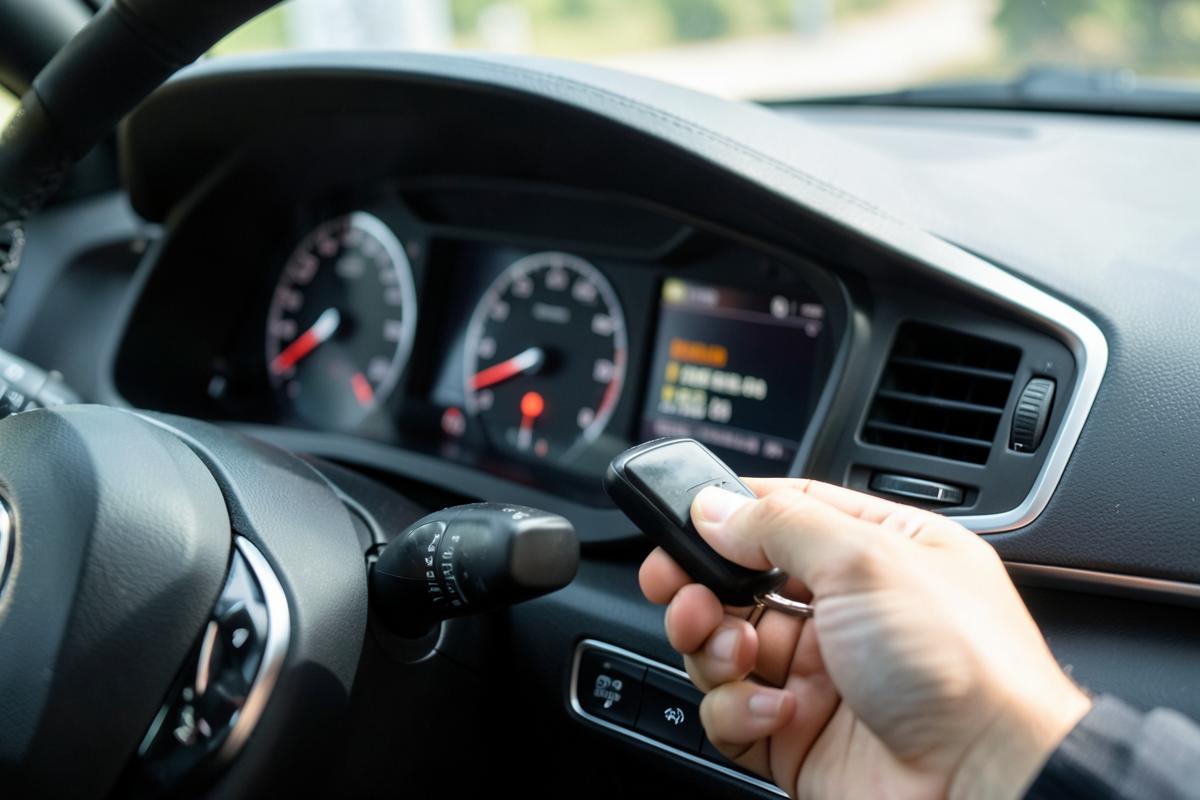
Nearly every push-to-start vehicle has a mechanical fallback for exactly this situation. Hold the fob physically against the start button and press — most manufacturers place a backup coil right behind or beside the button, close enough to power a dead fob's transponder chip by induction. Press firmly and hold for a second or two while you have the brake pedal down.
If that fails, check the steering column, the centre console cup holder, the wireless charging pad, or the passenger side of the console. Toyota, Honda, Nissan, Ford, Hyundai and Kia each mark a backup slot or zone somewhere in the cabin; the owner's manual page is usually titled "if the key fob battery is low." Place the fob there and press start with the brake down.
Getting in is a separate problem. Almost all smart fobs hide a mechanical emergency blade — slide the release catch and pull the metal key out. On most cars the driver door has a keyhole, sometimes behind a small plastic cap you pop off with the blade itself. Expect the alarm to sound when you open the door that way; starting the car normally silences it.
The five real causes, in the order worth checking
First, the fob battery. It is the cause about eight times out of ten, and a CR2032 or CR2025 costs a few dollars. A telltale sign is a fob that works only from a few inches away before failing completely.
Second, the car's own 12-volt battery. A weak vehicle battery can leave enough power for dash lights while starving the receiver module — you get a lit dashboard and a "not detected" message at the same time. If your engine has been cranking slowly, suspect this before the fob.
Third, interference. Airports, hospital car parks, radio towers, and even a phone or laptop resting on the same surface as the fob can drown out the signal. Step several feet away, move the fob to your other hand, and try again.
Fourth, physical or water damage. A fob that went through a wash cycle, took a hard drop, or has a hairline crack in the board may power up and still fail to transmit. Corrosion around the battery contacts causes the same symptom and is visible once you open the shell.
Fifth, lost programming or a failed receiver. Rare, but real — after a flat battery jump-start, a module replacement, or an aftermarket alarm install, a fob can lose its registration and need reprogramming to the vehicle.
A five-minute check you can do in the driveway
Try your spare fob. If the spare works, the problem is the first fob, and you have just saved yourself a diagnostic fee. If neither works, the fault is almost certainly on the car's side — battery, receiver or antenna.
Open the fob and look before you replace the battery. A battery sitting loose in its clip, a green-white powder on the contacts, or a bulging cell all tell a story. Clean contacts with a cotton bud and isopropyl alcohol, fit a fresh name-brand battery the right way up, and click the shell fully closed — a shell that does not seat properly keeps pressure off the contacts.
Finally, check for the obvious: a fob left in a bag with keys and coins can have a button pressed permanently, draining it in a day. A cracked shell with a loose button pad does the same thing.
When it is the shell, not the electronics
Years in a pocket wear out the button membrane and the plastic case long before the circuit board fails. If your buttons are worn smooth, the case is cracked, or the fob rattles, a shell replacement keeps the original electronics and costs a fraction of a new fob. The board and emergency blade transfer across in minutes, and no reprogramming is required because the chip never changes.
The trap is buying a shell that looks right in a photo but has a different button layout or blade profile. Match the FCC ID printed on the back of your fob's board, not just the car's make and model — the same vehicle often shipped two or three different fobs across trim levels and model years.
When you need a locksmith instead of a battery
Call a professional when a new battery and the backup start method both fail, when neither of your fobs is detected, or when the car intermittently loses the key while driving — that last symptom points to a receiver or antenna fault that needs diagnostic equipment, not guesswork.
A mobile automotive locksmith can test the fob's transmission on a bench tester, read the vehicle's immobiliser data through the OBD port, reprogram an existing fob that lost registration, or supply and program a replacement on the spot. That is usually a same-visit job at your home or workplace, without a tow to a dealership and without the multi-day wait for an ordered key.
Bring your ownership documents and photo ID to any key job — a locksmith who does not ask for proof that the car is yours is a locksmith to avoid.
Getting stuck in Austin, TX specifically
Two local situations produce this message more than any other. Summer heat is the first: a fob left on a dashboard in an Austin, TX parking lot in July regularly hits temperatures that shorten a coin cell's life dramatically, which is why so many "sudden" fob failures happen between June and September here.
The second is the downtown parking garages and the areas around Austin-Bergstrom, where dense radio traffic and concrete structures interfere with low-power fob signals. If your fob only misbehaves in one garage, that is interference, not failure — and the backup start method will get you home.
Wherever it happens, from Round Rock and Pflugerville to Cedar Park, South Congress or the Domain, a mobile locksmith can reach you rather than the other way around, which matters when the car will not start at all.
Preventing the next one
Change your fob battery on a schedule — once every two to three years — rather than waiting for failure. It is a two-minute job and removes the single most common cause entirely.
Keep the spare fob functional. A spare left in a drawer for five years has a dead battery of its own, so exercise it a few times a year. And if you only own one working key or fob for your car, treat that as a problem to solve now: originating a key when all keys are lost costs far more and takes far longer than adding a spare while everything still works.
Fob still not detected after a new battery? We test, reprogram, re-shell or replace smart fobs at your location across Greater Austin, TX — 24/7.
Key fob diagnosis & replacement in Austin, TX